
RESS-EC: Early Childhood Residency7
Connected Learning. Material Mastery.
Our face-to-face residency fosters deep personal collaboration among adult learners and faculty while building authentic, hands-on connections with the Montessori materials.
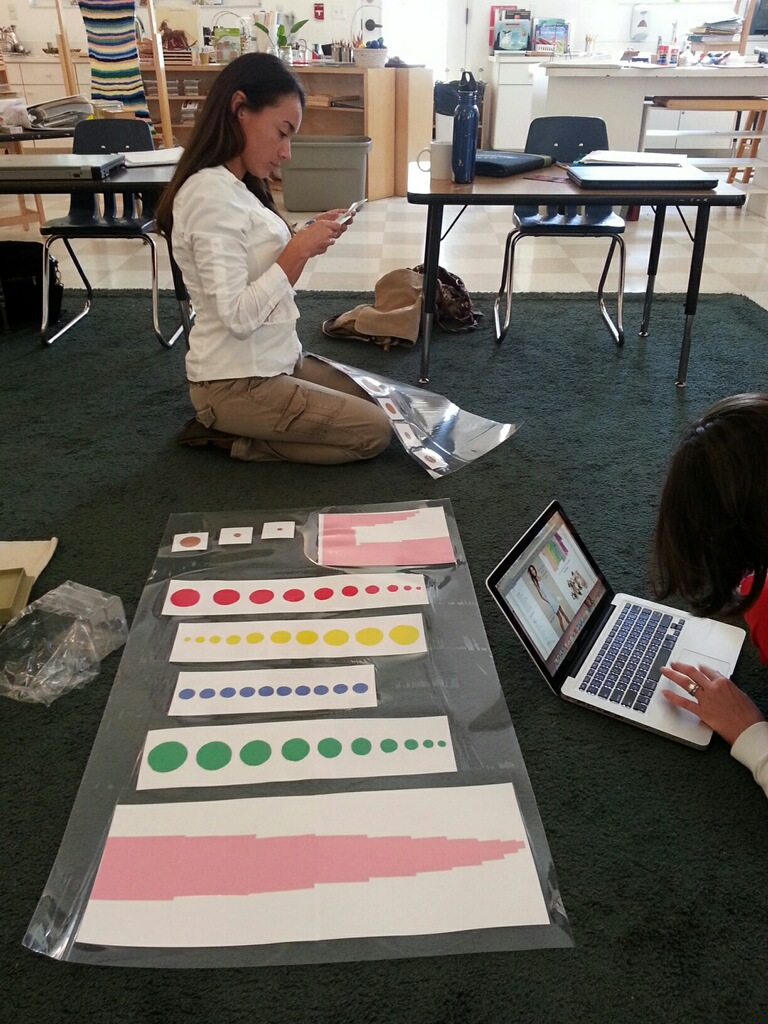
Areas of Exploration
Our Early Childhood Summer Residency Features:
* Foundational Theory & Leadership: Deep dives into Montessori philosophy, child development, the sensitive periods, and planning a seamless first day of school.
* The Prepared Environment: Designing spaces that foster self-direction and open-ended activities, paired with the spiritual preparation of the educator and peace education.
* Practical Life & Sensorial Foundations: Mastering grace and courtesy, building fine motor memory, and cultivating spatial thinking through sensorial-to-science sequences.
* Core Academics & Cultural Studies: Lectures, demonstrations, and practice labs covering Language Arts, Mathematics, Geography, History, Botany, and Zoology.
* Arts & Movement Integration: Weaving music, physical education, and health into daily curriculum design
* Classroom Operations & Management: Practical strategies for child observation, precise record-keeping, and building successful professional relations
The Foundation of Independence: Practical Life & Environmental Design
What You Will Master During the Residency Intensive:
- Cultivate Core Traits: Learn how to design a classroom environment that naturally fosters student concentration, coordination, order, and independence.
- Perfect the Presentation: Master the exact art, pacing, and choreography of presenting physical materials to young children.
- Implement Practical Skills: Gain hands-on experience with everyday tasks, including food preparation, household care, and self-care routines.
- Support Motor Development: Understand how to integrate physical exploration activities that refine gross and fine motor skills.
- Apply the Three-Period Lesson: Decode the pedagogical science behind the universal Montessori learning sequence: Introduce (Presentation), Remember (Practice), and Know (Mastery).
- Build Lifelong Foundations: Discover how early childhood material mastery creates the cognitive architecture for long-term academic success.
The Core of Sensorial Exploration
Sensorial work is not just about keeping a child busy; it is the systematic bridge between a child’s raw physical experience and their internal cognitive architecture.
- Isolation, Quality, and Refinement
- Isolating the Sense: True sensorial materials are engineered to isolate a single physical quality (e.g., color, weight, texture, or pitch). By keeping all other variables constant, the child’s focus is magnified on that specific attribute.
- Refinement of the Senses: Continuous exploration allows the child to fine-tune their perception, moving from gross differences to highly acute, subtle gradations.
- Physical and Cognitive Foundations
- Development of “Motor Memory”: Through repetitive, hands-on manipulation of materials (like the Cylinder Blocks or Pink Tower), muscles “remember” dimensions and weights. This physical memory anchors abstract concepts into the body before they reach the mind.
- Diagnostic Value for Adults: Sensorial work acts as an organic screening tool. Because the materials require specific physical responses, they provide a brilliant means for adults to detect deficits in a child’s sensory functions (such as subtle vision or hearing impairments) long before formal testing.
- Geometry and Spatial Thinking
- Pre-Mathematics: Long before learning formulas, children internalize geometry by handling it.
- Spatial Awareness: Working with shapes, volumes, and dimensions trains the child’s mind to calculate spatial relationships, recognize patterns, and understand the physical relationships among objects in three dimensions.
- The Road to Literacy & Handwriting
- Presentation of Language: Every sensorial material culminates in precise nomenclature (e.g., rough/smooth, large/small, isosceles/scalene). This rich vocabulary links a concrete experience to a specific word, feeding both receptive (understanding) and expressive (speaking) language skills.
- Preparation for Handwriting: The precise physical grip required by many materials—such as holding the tiny knobs of the Cylinder Blocks—directly trains the three-finger pincer grasp. This builds the exact muscular control, finger strength, and coordination needed to hold a pencil.
💡 Key Takeaway: Sensorial materials are “materialized abstractions.” They allow the young child to physically hold abstract concepts (like size, shape, and dimension) in their hands before their minds are ready to hold them conceptually.
Connecting the Child to the World From Sound to Self-Expression
Cultural studies in early childhood provide a cosmic framework, helping children understand their place in the universe, care for their environment, and develop a deep respect for all living things. It also provides the rich context and content that children naturally want to talk, read, and write about in their Language Studies. The language curriculum builds sequentially, moving from tactile phonetic awareness to mechanics, and ultimately to creative, independent expression. The two domains are entirely interdependent.
- Geography & Spatial Awareness
- Foundational Trinity (Land, Water, and Air): Introducing the three primary elements of our planet using concrete, sensorial models (like land and water globes and jars). This sets the stage for all future geography work.
- Micro-to-Macro Mapping: Scaffolding the abstract concept of maps by starting with the child’s immediate reality and expanding outward:
- The Hand & Body: Tracing and mapping physical selves.
- The Classroom: Transitioning to understanding aerial perspective and spatial layout.
- The Community: Connecting the classroom environment to the neighborhood and wider world.
- Biological Sciences
- Botany (Plants): * Learning the anatomical parts of plants (roots, stems, leaves, flowers) through nomenclature and puzzles.
- Practical life integration via the active caring for plants (watering, dusting leaves, planting seeds) to foster environmental stewardship.
- Zoology (Animals): * Introducing the broad domains and classification of the Animal Kingdom (Vertebrates vs. Invertebrates, followed by the five classes of vertebrates).
- Focus on sorting, characteristics, and respect for animal life.
- Language Studies
- Exploration with Language Materials: Utilizing tactile tools (like Sandpaper Letters and the Movable Alphabet) to link sounds to symbols, allowing children to manipulate language physically.
- Word Building & Beginning Reading: * Encoding (Writing): Children use the Movable Alphabet to analyze sounds in a word and build it before their hands are physically ready to write with a pencil.
- Decoding (Reading): Transitioning from building words to synthetically reading phonetically regular words, blends, and sight words.
- The Architecture of Language (Grammar):
- Function of Words: Introducing parts of speech through sensory experiences and games (e.g., bringing “the red ball” vs. “the blue ball” to experience adjectives).
- First Grammar Lessons: Using the traditional Montessori grammar symbols (like the black noun pyramid or red verb sphere) to visually map out sentence structures.
- Expression & Literacy Arts
- Creative Writing & Expressive Language: Moving past mere mechanics to help children find their own voice. Encouraging journaling, phonetic writing of original thoughts, and verbal expression of emotions and ideas.
- The Art of Storytelling: Cultivating listening skills, rich vocabulary, and imagination through oral histories, picture book analysis, and encouraging children to narrate their own lived experiences.
Group Discussions
The face-to-face early childhood summer residency includes:
- Open-ended activities
- Preparation, set-up, and clean up
- Exploration of creativity, movement, and healthy choices
- Self-direction and the learning community
- Flexibility, freedom, and responsibility
- Role of the teacher
- Early Childhood prepared environment design
- Emotional and intellectual environment
Daily Schedule 8:00 AM - 4:30 PM
Early Childhood Summer Residency (80 clock hours, 10 days)
- Day 1: Introductions, Early Childhood philosophy, and child development
- Day 2: Art Integration, music, health, and physical education, language arts
- Day 3: Language arts
- Day 4: Geography and history
- Day 5: Botany and zoology
- Day 6: Practical life
- Day 7: Practical life
- Day 8: Sensorial
- Day 9: Sensorial geometry
- Day 10: Math, money, time, and fractions
Material-Making Workshops
Discussions cover the importance of creating handmade, well-constructed materials and identifying areas of the learning environment that need supplemental materials.
Can the face-to-face residency be my first course?
Yes, the residency course is designed to help new educators become familiar with the materials and build basic knowledge for first-year teachers.
What do I need to bring with me to the residency?
The dress is casual and comfortable. You will need to bring a bag lunch, water, and snacks daily. All adult learners are asked to bring the following items: a laptop; any required manuals or textbooks; a cell phone and its charger; a phone and its charger; colored pencils; crayons; scissors; and cardstock or construction paper.
Where is the residency located?
LOCATION
Auburn Montessori School, The Children’s House, 231 E. Drake Ave., Auburn, Alabama 36830
What are the 2026 dates?
Week 1 – Tuesday, July 7, through Saturday, July 11, 2026
Sunday off
Week 2 – Monday, July 13, through Friday, July 17, 2026
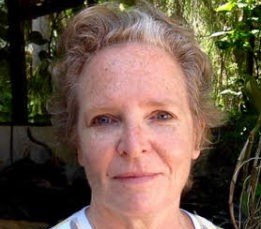
Kym Elder
Instructor
Dr. Kym Elder is the founder and executive director of Montessori Live. Kym holds a doctorate in instructional technology and distance education and a master’s degree in charter school educational leadership from Nova Southeastern University.
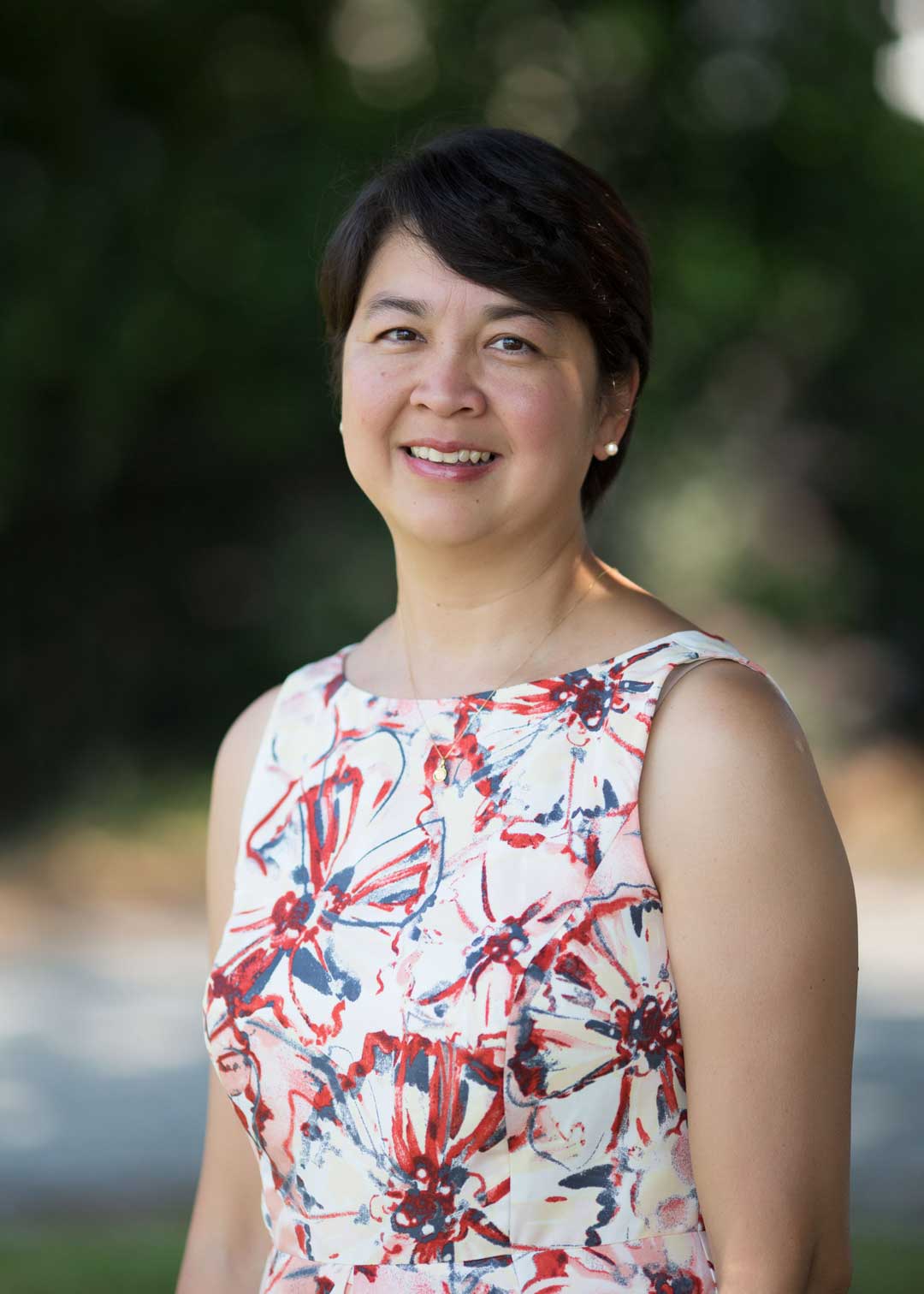
Charlene Kam
Instructor
Charlene Yvett Kam is an accomplished Montessori School Leader. She holds a Master’s Degree in Business Administration with specializations in Management Information Systems and International Business. Charlene founded Auburn Montessori School in 1997.
Forum Reflections
Each day, participants answer questions posted in the course’s forum. The questions cover the day’s subject matter and help the instructors determine the adult learners’ understanding and comprehension.
Art Integration
Art integration, language, cultural, and math extensions into art, material-making workshops, and practice with the materials are integrated into lessons throughout the residency.
Accredited Programs
Early Childhood (EC), Elementary I (EL I), Elementary I-II (EL I-II), and School Leadership
Textbooks and Required Manuals
You can either purchase the early childhood manuals from Montessori Research & Development (MRD) at https://www.montessorird.com or sign up for a 30-day virtual monthly subscription for $30 and access all manuals electronically.

Already a Student?
Montessori Live will enroll students in classes based on an agreed upon schedule. Contact registrar@montessorilive.org for changes to your schedule.

Already Enrolled?
Access MoodleRooms Classes
Ready to get started?
After you apply to become a student, you can begin taking courses.